
Introduction
Planning a maritime excursion often begins with a fundamental logistical question: How Many People Can Fit on a Sailing Yacht? While the answer might seem as simple as counting the number of seats or beds, it is actually a complex intersection of maritime law, vessel engineering, safety regulations, and comfort standards. In the modern sailing charter industry, understanding these limits is essential for both safety and the quality of the experience. As the demand for private yachting experiences grows, industry leaders like Salt-n-Sun Charter (available at https://saltnsuncharter.com/) emphasize the importance of matching the right vessel to the specific needs of a group. This guide provides an exhaustive analysis of the factors that determine yacht capacity, ranging from international legal frameworks to the physical dimensions of different hull designs.
Understanding Legal Limits: The Rule of 12
In the world of international yachting, the most significant number is 12. Most private sailing yachts, regardless of their size, are legally restricted to carrying a maximum of 12 passengers. This is not an arbitrary number chosen by boat builders; it is a strict regulation rooted in the International Convention for the Safety of Life at Sea (SOLAS). Under SOLAS, any vessel carrying more than 12 passengers is classified as a “passenger ship,” which subjects the vessel to much more rigorous construction, safety, and manning standards similar to those of a cruise ship or a commercial ferry.
Passenger vs. Crew Classifications
It is important to distinguish between “passengers” and “crew.” On a professionally crewed yacht, the captain and deckhands are typically not counted toward the 12-passenger limit. However, the exact definition can vary depending on the jurisdiction (such as the US Coast Guard versus European maritime authorities). For most recreational charters, the 12-passenger cap remains the industry standard to avoid the prohibitive costs and structural requirements of commercial passenger ship certification.
Yacht Size and Capacity Breakdown
Beyond the legal maximum, the physical size of the yacht dictates how many people can realistically and comfortably fit on board. The length overall (LOA) and the beam (width) of the vessel are the primary metrics for determining interior volume and deck space.
Small Sailing Yachts (30-40 Feet)
Yachts in the 30 to 40-foot range are typically designed for small families or couples. While a 38-foot yacht might be licensed for 8 to 10 people for a short day sail, the overnight capacity is usually limited to 4 or 6. These boats generally feature two or three small cabins and one or two heads (bathrooms). For a day trip, the cockpit space is the limiting factor, as it must accommodate everyone comfortably without obstructing the skipper’s ability to manage the winches and lines.
Mid-Size Cruisers (40-50 Feet)
This is the most popular category for sailing charters. A 45-foot monohull typically offers three to four cabins and can sleep up to 8 people. On a day charter, these vessels can easily handle 10 to 12 guests. The increased beam width in this size category allows for a larger salon area and a more spacious cockpit, ensuring that guests aren’t constantly bumping into one another during maneuvers.
Large Luxury Yachts (50-70 Feet)
Once a sailing yacht exceeds 50 feet, the focus shifts toward luxury and volume. These vessels often feature 4 to 6 en-suite cabins. Despite the massive increase in square footage, the legal limit of 12 passengers often still applies. However, the quality of the space is significantly higher. A 60-foot yacht provides enough deck space for multiple social zones, such as a foredeck lounge, a large cockpit dining area, and sometimes even a flybridge on modern designs.
Catamarans vs. Monohulls: The Space Revolution
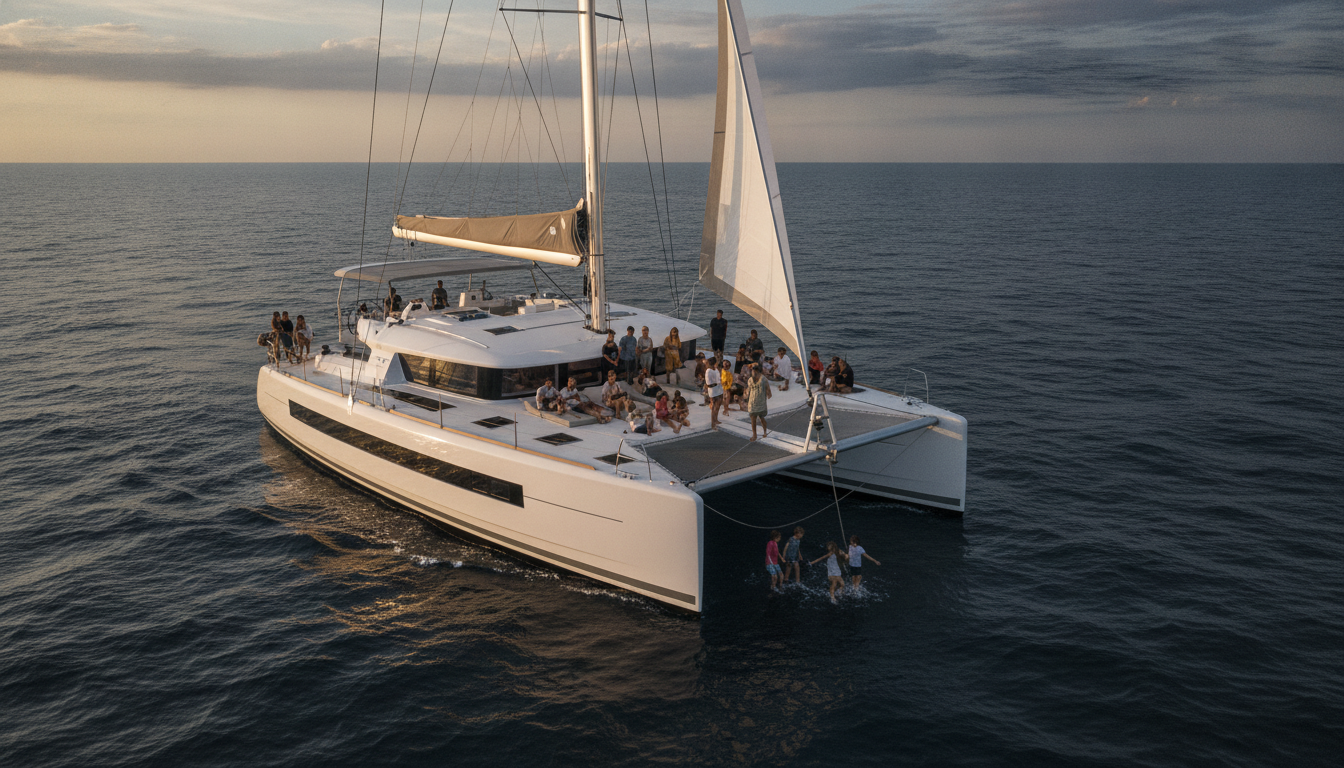
When considering how many people can fit on a sailing yacht, the hull type is arguably more important than the length. The rise of the catamaran has revolutionized charter capacity. Because catamarans consist of two hulls joined by a wide bridge deck, they offer a rectangular footprint rather than the tapered, triangular footprint of a monohull.
- Stability: Catamarans do not heel (tilt) like monohulls, making the space more usable for more people simultaneously.
- Living Space: A 40-foot catamaran often has the interior volume and deck space of a 50-foot monohull.
- Privacy: Cabins are located in the corners of the hulls, providing better separation for guests.
For large groups of 10 to 12, a catamaran is almost always the preferred choice because it allows for a massive central salon and an expansive “trampoline” area at the bow where many guests can lounge at once.
Day Charters vs. Overnight Accommodations
The capacity of a yacht changes drastically based on the duration of the trip. Day Charters focus on deck space and seating. If a boat has enough life jackets and stability, it may be rated for more people during daylight hours than it can sleep. Overnight Charters, however, are strictly limited by the number of berths (beds). It is generally considered poor practice to have guests sleeping in the salon (the common living area) on a luxury charter, so the number of cabins usually dictates the guest count.
Safety Regulations and Life-Saving Equipment
Regardless of how many people can physically stand on a deck, the number of people allowed is ultimately limited by the safety equipment on board. Every yacht must carry:
- Life Jackets: One for every person on board, including specialized jackets for children.
- Life Rafts: These must have a total capacity exceeding the maximum number of people allowed on the vessel.
- Stability Criteria: Naval architects calculate the “righting moment” of a yacht. Too many people on one side of a small boat can create a capsize risk, which is why smaller boats have lower legal capacities.
Summary Table of Capacity
The following table provides a general estimate of capacity based on standard yacht configurations. Note that specific boat models may vary.
| Vessel Type | Length (LOA) | Max Day Guests | Max Overnight Guests | Ideal Group Size |
|---|---|---|---|---|
| Small Monohull | 32-38 ft | 6-8 | 4 | 2-4 |
| Medium Monohull | 40-48 ft | 10-12 | 6-8 | 6 |
| Large Monohull | 50-65 ft | 12 | 8-10 | 8 |
| Small Catamaran | 38-42 ft | 12 | 6-8 | 6 |
| Large Catamaran | 45-55 ft | 12+ (if certified) | 10-12 | 10 |
Frequently Asked Questions
1. Can I bring 13 or 14 people if some are children?
In the eyes of maritime law, a soul is a soul. Infants and children count toward the total passenger manifest. Exceeding the licensed capacity can void the vessel’s insurance and lead to heavy fines for the captain.
2. Does the crew count toward the 12-passenger limit?
On most commercially registered yachts, the crew is separate from the passenger count. However, on “bareboat” charters where you hire a skipper separately, the rules can be more nuanced. Always check with your charter provider.
3. Why are some yachts limited to 6 passengers in the US?
In the United States, vessels that do not have a formal USCG Certificate of Inspection (COI) are limited to 6 passengers under the “Uninspected Passenger Vessel” (UPV) or “6-pack” regulations.
4. What is the most comfortable number of people for a 40-foot yacht?
While it can fit more, 6 guests is usually the “sweet spot” for a 40-foot boat to ensure everyone has enough personal space and storage for luggage.
5. Do catamarans always have more space than monohulls?
Yes, in terms of usable square footage and social areas, a catamaran will almost always offer more space than a monohull of the same length.
Conclusion
Determining how many people can fit on a sailing yacht requires a balance between legal requirements, safety standards, and personal comfort. While the “Rule of 12” governs the majority of the charter industry, the physical layout of the boat—specifically whether it is a monohull or a catamaran—will dictate the actual quality of the experience. For those looking to host a group, it is vital to consult with experts and choose a vessel that offers the right number of cabins and sufficient deck area. By prioritizing safety and adhering to maritime regulations, you ensure that your time on the water is not only memorable but also secure. When you are ready to book your next adventure, remember that selecting the right capacity is the first step toward a perfect voyage.


