
Introduction
In the contemporary era of maritime exploration, the choice between a catamaran and a traditional sailing yacht (monohull) represents more than a mere preference in vessel design; it reflects a fundamental decision regarding lifestyle, performance, and comfort on the open sea. As the global yacht charter industry experiences a significant surge in demand, discerning travelers and aspiring sailors often find themselves at a crossroads. The evolution of naval architecture has bridged many gaps between these two vessel types, yet the core differences remain rooted in physics, spatial ergonomics, and hydrodynamic efficiency. Understanding What Is the Difference Between a Catamaran and a Sailing Yacht? is essential for anyone looking to invest in a vessel or book a luxury vacation. While the classic sailing yacht offers a timeless, romantic connection to the ocean, the catamaran has redefined the concept of a floating villa. This comprehensive guide delves into the technical, practical, and experiential distinctions to help you navigate your next nautical adventure.
Hull Configuration and Hydrodynamics
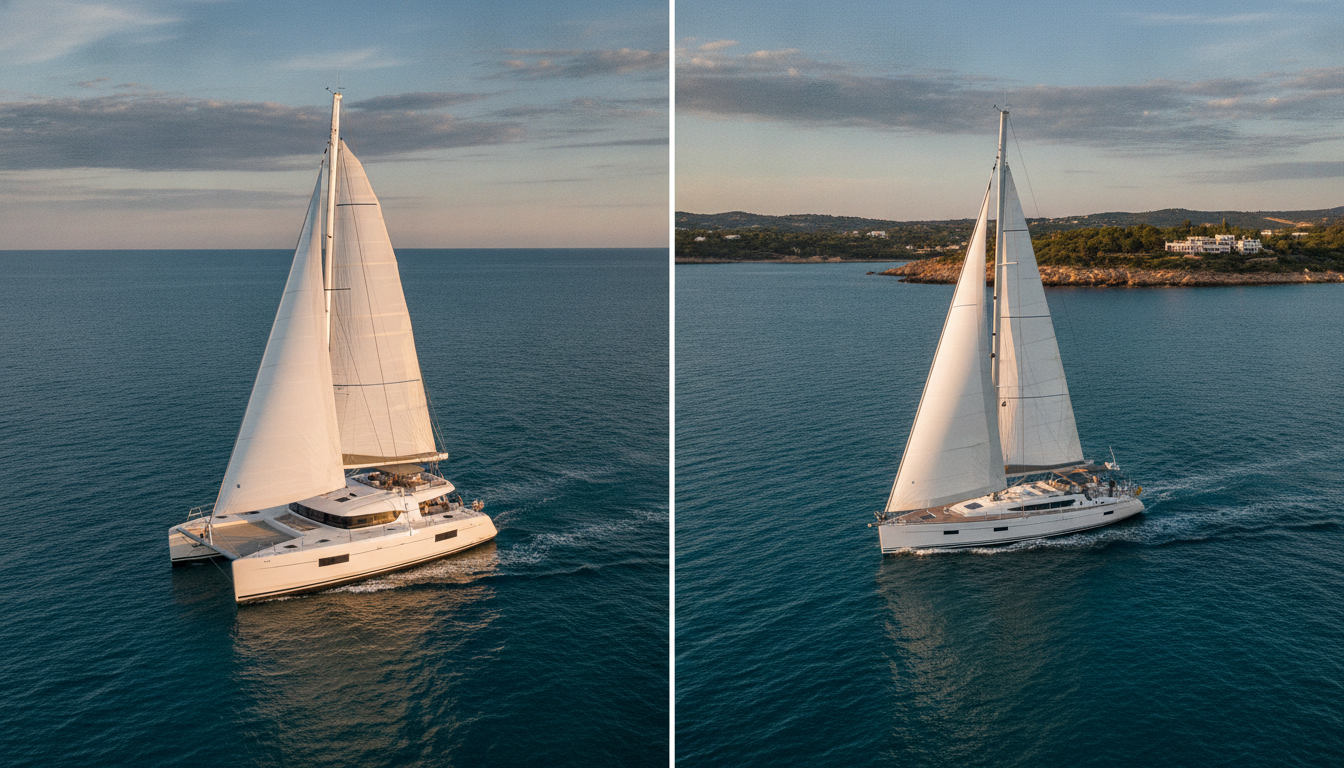
The most visible distinction lies in the hull configuration. A traditional sailing yacht is a monohull, meaning it relies on a single, central hull that sits deep in the water. To prevent the boat from capsizing under the force of the wind on its sails, a monohull utilizes a heavy, ballasted keel. This design creates a low center of gravity but also results in a significant amount of displacement and drag. Conversely, a catamaran is a multihull vessel featuring two parallel hulls joined by a bridge deck. Catamarans derive their stability from their wide beam (width) rather than a weighted keel. This lack of a heavy keel allows catamarans to be significantly lighter and sit higher in the water, a characteristic known as a shallow draft. From a hydrodynamic perspective, the two hulls of a catamaran create less resistance at higher speeds compared to a single, wide monohull, though the monohull typically offers superior tracking and performance when sailing close to the wind.
Stability and the Physics of Heeling
For many, the defining characteristic of a sailing yacht is ‘heeling’—the way the boat leans over to one side when catching the wind. While seasoned sailors often find the sensation of heeling exhilarating, it can be challenging for those prone to seasickness or those who prefer a level platform. A monohull must heel to find its equilibrium. In contrast, a catamaran stays almost perfectly level, even when under sail. This stability makes catamarans exceptionally popular for families and those new to sailing. On a catamaran, movement throughout the deck and interior is safer and more comfortable while underway, as there is no need to ‘climb’ up the high side of the boat. This difference in stability also affects how the vessel handles waves; while a monohull might roll in a swell, a catamaran can sometimes experience a ‘hobby-horsing’ motion or a sharp ‘snap’ back to level, which is a different but generally more stable sensation.
Space, Layout, and Living Ergonomics
When comparing internal volume and deck space, the catamaran almost always wins on sheer square footage. Because the beam of a catamaran is often half the length of the boat, the living area is massive. In a modern catamaran, the saloon (living room) and galley (kitchen) are typically located on the same level as the cockpit, creating a seamless indoor-outdoor living space. This ‘one-level living’ is a major draw for charter guests. On a sailing yacht, the living quarters are located ‘downstairs’ inside the hull. While this creates a cozy, protected environment that many traditionalists love, it can feel more confined. In terms of privacy, catamarans offer a distinct advantage: the sleeping cabins are usually located in the corners of the two separate hulls, providing excellent separation between guests. In a monohull, cabins are often adjacent to one another, separated only by thin bulkheads.
Deck Space and Amenities
The expansive deck of a catamaran allows for amenities that are rare on monohulls of a similar length. This includes large trampolines at the bow—perfect for sunbathing and watching dolphins—and often a ‘flybridge’ or upper deck for elevated views. Sailing yachts, while having less surface area, offer a more intimate connection to the water. The cockpit of a monohull is often deeper and more protected, which can feel more secure in heavy weather. However, for those looking to host large groups or enjoy alfresco dining, the wide aft deck of a catamaran is difficult to beat. For those planning a luxury getaway, companies like Salt-n-Sun Charter provide a range of both vessel types, allowing guests to choose the layout that best fits their group dynamic.
Performance and Sailing Characteristics
The debate over performance is nuanced. Sailing yachts are generally considered superior when sailing ‘upwind’ (closer to the direction the wind is coming from). Their deep keels allow them to point higher and experience less ‘leeway’ (sideways drift). They are also more maneuverable in tight spaces under sail. Catamarans, due to their light weight and lack of a keel, are exceptionally fast on a ‘reach’ (wind coming from the side) or when sailing downwind. Because they don’t have to push a heavy keel through the water, they can often reach speeds that would be impossible for a monohull of the same size. However, catamarans can struggle in heavy head-seas, as the bridge deck (the area between the hulls) can ‘slam’ against the waves. Monohulls tend to slice through waves more cleanly, providing a smoother ride in rough, upwind conditions.
Maneuverability Under Power
Under engine power, catamarans have a distinct advantage. Most catamarans are equipped with two engines—one in each hull—spaced far apart. This allows the captain to spin the boat 360 degrees on its own axis by putting one engine in forward and the other in reverse. This makes docking a large catamaran surprisingly easy. A monohull usually has a single engine and a single rudder, making it more dependent on the flow of water over the rudder to turn, which can be tricky in tight marinas, especially when wind or current is a factor.
Draft and Coastal Accessibility
One of the most practical differences is the ‘draft’—the minimum depth of water required to float the boat. A 50-foot sailing yacht might have a draft of 7 to 9 feet, meaning it cannot enter shallow bays or get very close to the beach. A 50-foot catamaran, however, usually draws only 3 to 4 feet. This allows catamarans to anchor in secluded, shallow lagoons that are inaccessible to monohulls. In destinations like the Bahamas or the British Virgin Islands, where the water is famously shallow, the catamaran’s low draft is a significant benefit, allowing guests to step off the boat directly onto a sandbar.
Comparative Overview Table
The following table summarizes the key technical and experiential differences between the two vessel types:
- Stability: Monohulls heel (lean); Catamarans stay level.
- Space: Monohulls have vertical living (below deck); Catamarans have horizontal, wide-beam living.
- Draft: Monohulls (Deep, 6-10ft); Catamarans (Shallow, 3-4ft).
- Upwind Performance: Monohulls (Excellent); Catamarans (Average to Poor).
- Downwind Speed: Monohulls (Good); Catamarans (Excellent).
- Privacy: Monohulls (Moderate); Catamarans (High, separate hulls).
- Docking Fees: Monohulls (Standard); Catamarans (Often 1.5x to 2x due to width).
Cost and Maintenance Considerations
Owning or chartering a catamaran generally comes with a higher price tag. In a charter context, catamarans are more expensive because they offer more space and are in higher demand. For owners, the costs are doubled in many areas: two engines to service, two hulls to clean, and double the amount of anti-fouling paint. Furthermore, because catamarans take up significantly more space in a marina, dockage fees are often calculated at a premium, sometimes 50% to 100% more than a monohull of the same length. However, the resale value of catamarans has historically remained very strong due to their popularity in the global charter market.
Frequently Asked Questions
Is a catamaran safer than a sailing yacht?
Both are extremely safe when handled by a competent crew. A monohull is ‘self-righting’ due to its ballasted keel, meaning if it knocks over, it will pop back up. A catamaran is nearly impossible to capsize under normal conditions due to its width, but if it does flip, it stays flipped. However, catamarans are considered ‘unsinkable’ because they are often built with buoyant materials and lack a heavy lead keel.
Which is better for someone prone to seasickness?
A catamaran is generally better for those prone to motion sickness. Its stability and lack of heeling provide a more consistent platform. Additionally, being able to stay on the main deck level with a view of the horizon while cooking or relaxing helps the brain process motion better than being ‘down below’ in a monohull.
Do catamarans use more fuel?
While catamarans have two engines, they are often more fuel-efficient at cruising speeds because the hulls are narrower and have less drag than a single large monohull. However, running both engines simultaneously will naturally consume more fuel than a single-engine monohull.
Can a sailing yacht go faster than a catamaran?
In a straight line with the wind behind or to the side, a catamaran is usually faster. However, in a race involving upwind legs or very light winds, a high-performance sailing yacht may have the advantage due to its superior aerodynamic and hydrodynamic efficiency at those angles.
Which is better for a family vacation?
Most families prefer catamarans. The extra space, the safety of a level deck, the separate living areas for kids and parents, and the ability to anchor closer to shore make it the ultimate platform for a family holiday.
Conclusion
Choosing between a catamaran and a sailing yacht ultimately depends on your priorities. If you value the traditional art of sailing, the thrill of heeling, and the ability to point high into the wind, a sailing yacht offers an unmatched, soulful experience. It is the choice of the purist. However, if your goals are maximum comfort, social space, stability, and the ability to explore shallow coves, the catamaran is the clear winner. Both vessels offer a unique way to experience the majesty of the ocean. Whether you seek the classic lines of a monohull or the expansive luxury of a multihull, understanding What Is the Difference Between a Catamaran and a Sailing Yacht? ensures that your time on the water is perfectly aligned with your expectations. For those ready to embark on their next journey, selecting the right vessel is the first step toward an unforgettable maritime legacy.


